Dana Houston Jackson · Founder and Chief Operating Architect, Change – With a Coach Approach, LLC
Activity is not capability
Dana helps leaders make change less confusing, less painful and far more useful. As an AI ways-of-working architect, she helps organizations move from AI access to real adoption.
We had the pleasure of Dana facilitating a leadership workshop for a small group at Kimley-Horn. The focus was Engineering a Change Mindset. Dana did an absolutely fantastic job. Her preparation was extraordinary. It felt like she had worked with our firm for years by the time we got to the workshop. She engaged all 13 of us throughout the session, making it very interactive. I would strongly encourage other leaders looking for insights on change mindset and management to work with Dana.
I had the pleasure of working with Dana during her tenure as an Organizational Change Manager consultant for Microsoft. I can confidently say that her impact was immediate and substantial. Dana excelled in her role by setting up effective change management strategies and also took the initiative to educate our team on the fundamentals of OCM. Her dedication to coaching and upskilling our team ensured that we not only adapted to change more effectively, but also acquired valuable skills for future initiatives. What stood out most about Dana was her ability to grasp our organization’s complex interdependencies and silos. She didn’t hesitate to immerse herself in understanding our unique challenges. In fact, whenever Dana attended meetings, they seemed to run more smoothly — a testament to her knack for bringing clarity and direction to discussions. Dana’s professional demeanor, alongside her proactive approach to learning and teaching, made her a valuable asset to our team. I highly recommend her for any role where expertise in organizational change management and a collaborative spirit are valued.
Dana brings a thoughtful, strategic perspective to AI adoption and acceleration, with a particular focus on helping organizations prepare their people, processes, and culture for emerging technologies. She understands that successful AI adoption goes beyond technology. It requires aligning organizational readiness, employee engagement, and business objectives. Dana brings valuable perspective to customer conversations, helping organizations explore opportunities to accelerate adoption and realize the potential of AI.
Dana has supported me for the last several years delivering a large EAM consolidation/upgrade program (a portfolio of projects). Dana is an excellent change management leader, and SME, and has done great work for me focusing on program CM&T strategy and tactics. Additionally, Dana is a skilled Change Management and project leadership coach. Dana has supported me in this coaching capacity since the middle of 2022; this has greatly benefited me in continuing to lead my program through challenging waters. I really appreciate Dana’s willingness to help me, and the program, succeed.
I recommend Dana for expertise in project and change management. Dana has "on-the-ground" experience in working with utilities all the way up through consulting with executive leaders. You can be sure that if you need to know something about "how-to" change management work, Dana has the solution and can implement it well. Additionally, Dana is an expert public speaker and she has delivered high-end presentations for Change Management Review and received multiple accolades for her well-presented actionable content.
I recently partnered with Dana on a challenging project that focused on adapting to change as a company. She played a key part in how we developed our strategy, worked closely with our leadership, and provided tremendous value. Looking forward to continuing the partnership.
Dana’s comprehensive understanding of change management principles, combined with a deep commitment to organizational development, truly sets her apart. She has been pivotal in leading our team through significant organizational transitions, always considering both the human and operational implications of change.
I knew Dana was the perfect fit for a change management leadership role within my program. Without any hesitation, she took the plunge, quickly forming vital connections, discerning the key focus areas for change management, and devising an effective plan within an impressive timeframe. Dana is not merely a change management leader; she is a catalyst for transformation, putting people first and utilizing technology to enhance outcomes.
Dana is an incredible force of nature in the field of organizational change management. She has guided my team to more carefully focus on the outcomes and measurement of change programs. She is also an inspiring leader with excellent listening skills and a focus on delivering value.
Dana is a dynamic change leader with a passion to support people-centered change in organizations. Her expertise incorporates various frameworks from her broad experience across disciplines and industries. Her energy and enthusiasm is inspirational. I have had the pleasure to co-present with this her and her unique perspective helped me see engagement in a different way.
I had the good fortune of finding Dana after listening to the Change Management Review podcast. I reached out in hopes she might provide mentorship for a large business transformation project I needed help with. She was very eager to assist, provided book and course recommendations, and shared some of her unlimited knowledge and extensive experience. Dana's advice and leadership has been invaluable and she has opened up new opportunities for me I could not have imagined pursuing. Dana is a true rock star of all things change!
Dana Houston-Jackson is simply awesome. Any random question I have for her, she knocks the response out of the ball park. She goes above and beyond to help explain concepts in a meaningful and relatable way – amazing teacher and trainer. I am so appreciative of the time she has given me over the past year. I have learned so much thanks to her unwavering guidance both in change management and project management. She reads people like no one I’ve seen before – knows why they provided the answer to a certain question and helps to explain the concepts behind the thinking – all while making complete sense. So incredibly powerful. I learn something new and valuable every single time I’m with Dana. She is an amazing asset to BMcD and 1898 & Co.
Dana brings tremendous depth in change management to her projects. She is a perpetual student with an intense desire to improve her understanding of the discipline. She is never satisfied with the status quo and is always looking for ways to help those around her by equipping them with tools, skills, and resources necessary to be successful. It has been my pleasure working with her to absorb some of her knowledge and apply these principles in my own personal and professional life.
Dana Houston Jackson, served as Managing Director, Adoption Readiness & AI Acceleration at itD. Dana was an active and visible representative of our brand, regularly engaging with industry audiences and strategic partners on behalf of itD. Her work included public speaking engagements, industry conference participation, and direct relationship-building with enterprise partners, reflecting strong communication skills and an ability to represent an organization credibly in front of senior external stakeholders. Dana was also a strong team contributor. She worked collaboratively with colleagues across the organization and had a positive impact on the people and projects around her.
Dana is a powerhouse… Simply put, if you have an opportunity to work with Dana individually or as a part of your team, I would recommend that you take advantage of her brilliance, grit, and tenacity.
Dana is an outstanding person with an insane work ethic. I have had the pleasure of working with her in graduate school for our classes. She taught me so many skills, both inside and outside of the classroom. Dana is very inspiring to me. Anyone who has the honor of working with her is in great hands. She has a wealth of knowledge, experience, and wisdom. What a great coach to have on your side. Dana is well-recommended!
What Dana delivers
Attendance and activity are not adoption.
Built with people, not handed to them.
Leaders are good at launching things: tools, processes, reorganizations, AI. The space between the launch and lasting capability is where Dana works.
Ideas built from the work, not from the sidelines.
My books grow out of problems I and others have encountered repeatedly inside organizations. They are written for leaders and practitioners who need ideas they can actually use.
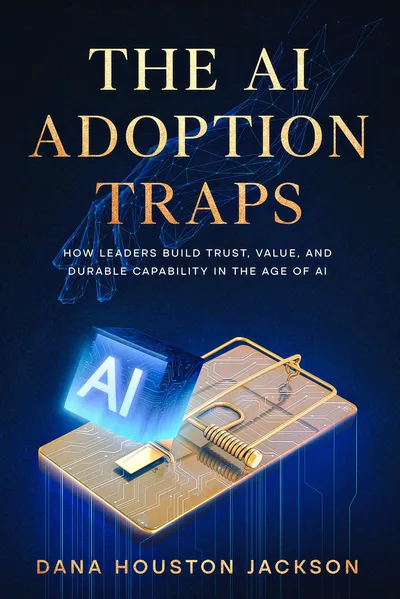
The AI Adoption Traps
How Leaders Build Trust, Value, and Durable Capability in the Age of AI
Organizations are investing heavily in artificial intelligence. But installing AI is not the same as adopting it. And using AI is not the same as creating value.
The goal is not AI everywhere. The goal is responsible AI creating measurable value through better work.
By Zac Jarrard, Dana Houston Jackson and Douglas Wood · Taylor & Francis
For the first time, many organizations are asking five generations of employees to work together while technology simultaneously changes what work means. Leading a 5 Generation Workforce moves beyond stereotypes to examine a more useful question: How do we design leadership and work so people with different experiences can succeed together?
Today's thinkers already know what AI transformation needs. Part 7 of The Inherited Operating System: the new code, and the newer management ideas now…
Maybe your organization has invested in AI and adoption isn’t happening as expected. Maybe a major organizational change is technically on track but the organization is struggling to absorb it. Maybe your leadership team needs a different conversation. Maybe you need someone who will challenge the assumptions in the room rather than simply reinforce them.
Or maybe you have a problem that doesn’t fit neatly into a menu. That’s fine. Start with the problem. We’ll figure out the next question together.