Half of Workers 50 and Older Want AI Training. One in Eight Has Had It.
I’m continuing my research and development of AI impacts on our most seasoned generations. Folks from each generation have a different learning style and experience. How they assimilate, how they reach conceptual understanding and how they practice to gain confidence is different generation to generation – for the most part.
With considerable “family internal marketing” on my part, my Silent Gen and Baby Boomer parents are having an affair with Grok – or as my dad calls it, “Grok-ette.” My Baby Boomer husband is quietly testing features at his own pace. As a Gen X with an affinity for technology, I’ve leaned all the way in and I’m fully immersed. Same tools. Three different ways in.
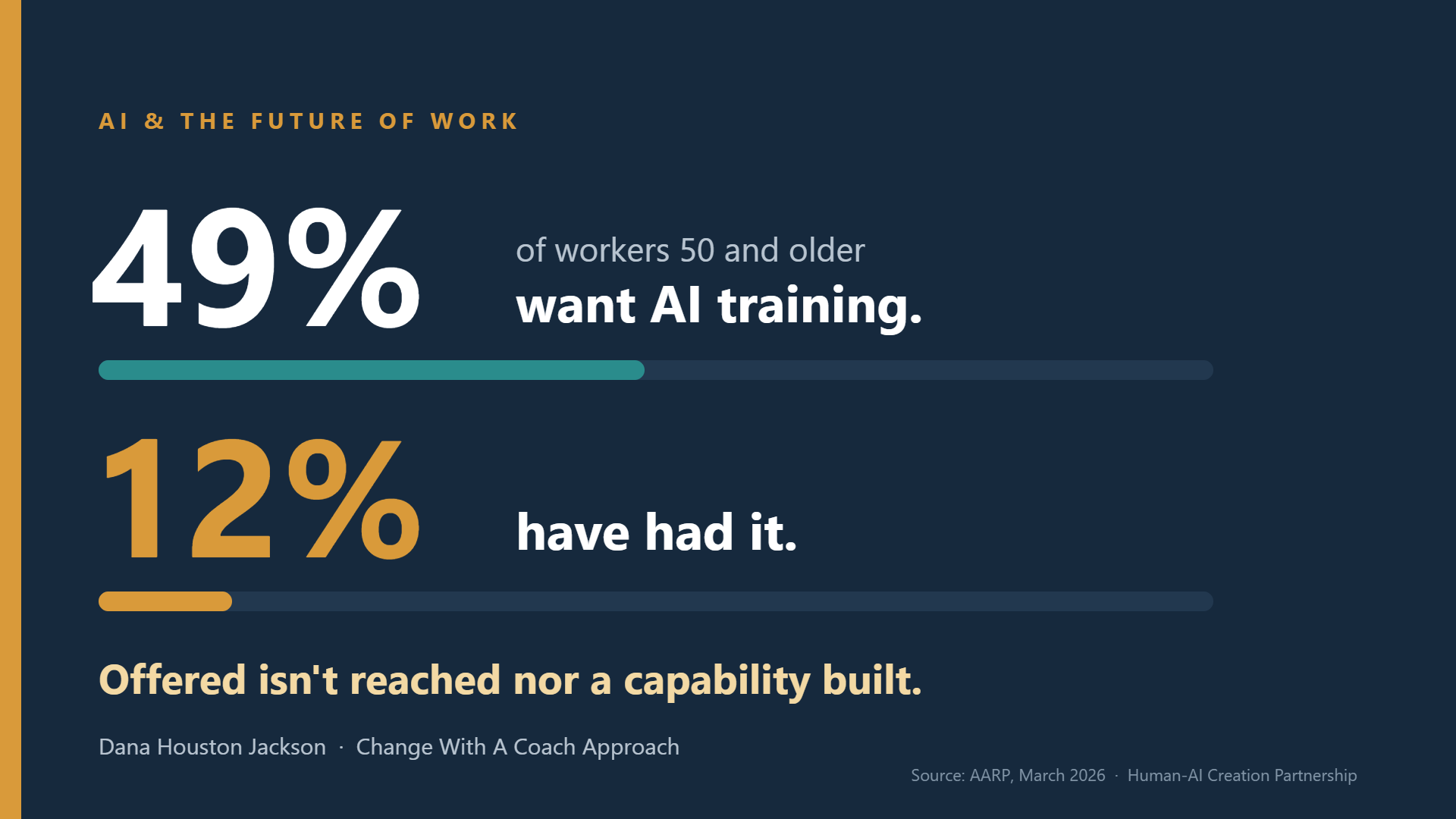
At home, everybody gets to learn their own way. At work, it’s a different story. Nearly half of workers 50 and older want AI training. 12% have had it. (AARP, March 2026). That’s a 37-point gap between “I want to learn this” and “somebody taught me.”
Now ask employers. 83% say they provided AI training in the past year. 97% say it’s inclusive for all ages. (AARP employer survey, 2026)
Then ask the workers. 63% of those 50 and older say their employer isn’t doing enough. Only 31% say AI training is offered to everyone regardless of age. Both can’t be right. Offered isn’t reached. And a training catalog option isn’t a built-capability in a human.
The assumption doing the damage
76% of U.S. adults agree that people assume “older employees” are less comfortable with new technology. That’s the survey’s wording, and the assumption in two words. (CWI Works and Ipsos, July 2026)
Seasoned professionals feel it. A third of workers 50 and older say people their age are assumed to be less tech-savvy. One in five say younger employees get preferred for training. (AARP, 2026)
It shows up in hiring too. In a 2024 survey, 90% of U.S. hiring managers said they’d consider candidates under 35 for AI roles. For candidates over 60 it was 32%. The same managers said workers 45 and older perform as well as or better than younger colleagues. (Generation, October 2024)
Read that again. Good performers. Wrong birth year. There is a reason “as well or better” was the response.
Meanwhile our experienced professionals being written off are getting on with it. The share of workers 50 and older using AI in their work went from 14% to 23% in two years. With or without the training.
This is a five-generation problem
Last time I wrote about the bottom of the generational ladder with our Gen Z and even Alphas. AI is taking the small jobs where early-career people used to build judgment.
This is the other end of the same ladder. The people with the judgment aren’t getting the tools. The people with the tools aren’t getting the judgment.
That’s not an age problem. It’s a design problem, and it belongs to all of us, especially leaders.
Where to start
- Count who took the training, not who was invited. Break it out by age band and job level. If you can’t produce that number, you don’t know whether your training is inclusive. You only know it was announced.
- Ask the people who didn’t take it why. Was it scheduled during their busiest shift? Built around tools they don’t use? Assumed they wouldn’t want it?
- Train on the real work, in mixed-age pairs. One person brings speed with the tool. The other brings the judgment to know when the output is wrong. Both leave better.
- Stop letting “AI role” mean “under 35.” Write the role around the judgment it takes to use AI well, then see who qualifies.
- Measure capability, not attendance. What can your people do with AI now that they couldn’t six months ago? All of your people.
Activity isn’t adoption. Access isn’t adoption either.
This is what I’m writing about in The AI Adoption Traps and in Leading a Five Generation Workforce (Taylor & Francis, April 2027). Five generations share the same workplace. The organizations that get value from AI will be the ones that bring all five along.
So, here’s my question for you: who in your organization wanted the AI training and never got it? Tell me in the comments. I’m listening.
Quick Answers
How many workers 50 and older have had AI training?
Nearly half of workers 50 and older want AI training, but only 12% have had it, according to AARP research from March 2026. That’s a 37-point gap between wanting to learn and being taught.
Why are older workers left out of AI training?
Often it’s the assumption that older employees are less comfortable with technology. Training gets offered but doesn’t reach people: 83% of employers say they provided AI training, yet only 31% of workers 50 and older say it’s offered to everyone regardless of age.
How can organizations make AI training inclusive across generations?
Count who actually took the training by age band and job level, ask non-participants why, train on real work in mixed-age pairs, write AI roles around judgment rather than age and measure capability instead of attendance.
More on AI and the workforce

Dana Houston Jackson is the founder of Change With A Coach Approach, LLC and the author of The AI Adoption Traps. She started in manufacturing, spent 10 years in construction, taught K-12 and university students, and ran technology projects as a scrum master and project manager. As a consultant she has stood up project management and change management offices and trained clients across industries, including work with the Department of Energy. She’s a speaker, advisor and executive coach with 30+ years in the work, now focused on helping leaders turn AI activity into lasting capability.