I created the AI Adoption Traps Framework to show why so many organizations generate plenty of AI activity without ever building lasting capability. The framework identifies five traps that keep companies stuck: treating speed as progress, chasing savings instead of value, assuming literacy will create leaders, assuming people will trust AI because leadership does, and trying to scale before anything has actually taken hold. The point is not that AI is failing. It is that organizations are often measuring motion instead of adoption, and they are trying to expand something that has not yet become real in the work.
The O-R-A-V Model
A Dana Houston Jackson framework

I created the O-R-A-V Model for quality professionals in ASQ after seeing a recurring problem: organizations can complete a corrective action, close the documentation, and still fail to change what actually happens in the work. O-R-A-V stands for Ownership, Reinforcement, Adoption, and Verification. Who owns the whole change, not just the assigned tasks? What are leaders continuing to reinforce after approval? What actually changed in daily work? And how do we know the new way still works under real pressure? The model is not about adding more bureaucracy. It is about closing the gap between technical closure and durable change.
Scale and Responsiveness

As organizations grow, leaders usually want two things at the same time: more consistency and more responsiveness. The problem is that growth often brings more approvals, more coordination, slower decisions, and less room for local judgment. I created this model for senior leaders in a large AEC firm wrestling with exactly that tension across geographically dispersed teams. The point is simple: scale and responsiveness can coexist, but only if the organization is designed for both. If you add size without redesigning decision rights, coordination, and local authority, the organization usually gets heavier before it gets better.
The AI Adoption Trap Model
A Dana Houston Jackson framework

Implementation and adoption are not the same thing. The Adoption Gap is the space between making a new solution available and seeing meaningful, sustained changes in work and performance.
Closing that gap requires more than communication and training. It requires trust, work redesign, leadership behavior, feedback, learning, and evidence that the new approach actually produces value.
Trust Before Scale
A Dana Houston Jackson framework
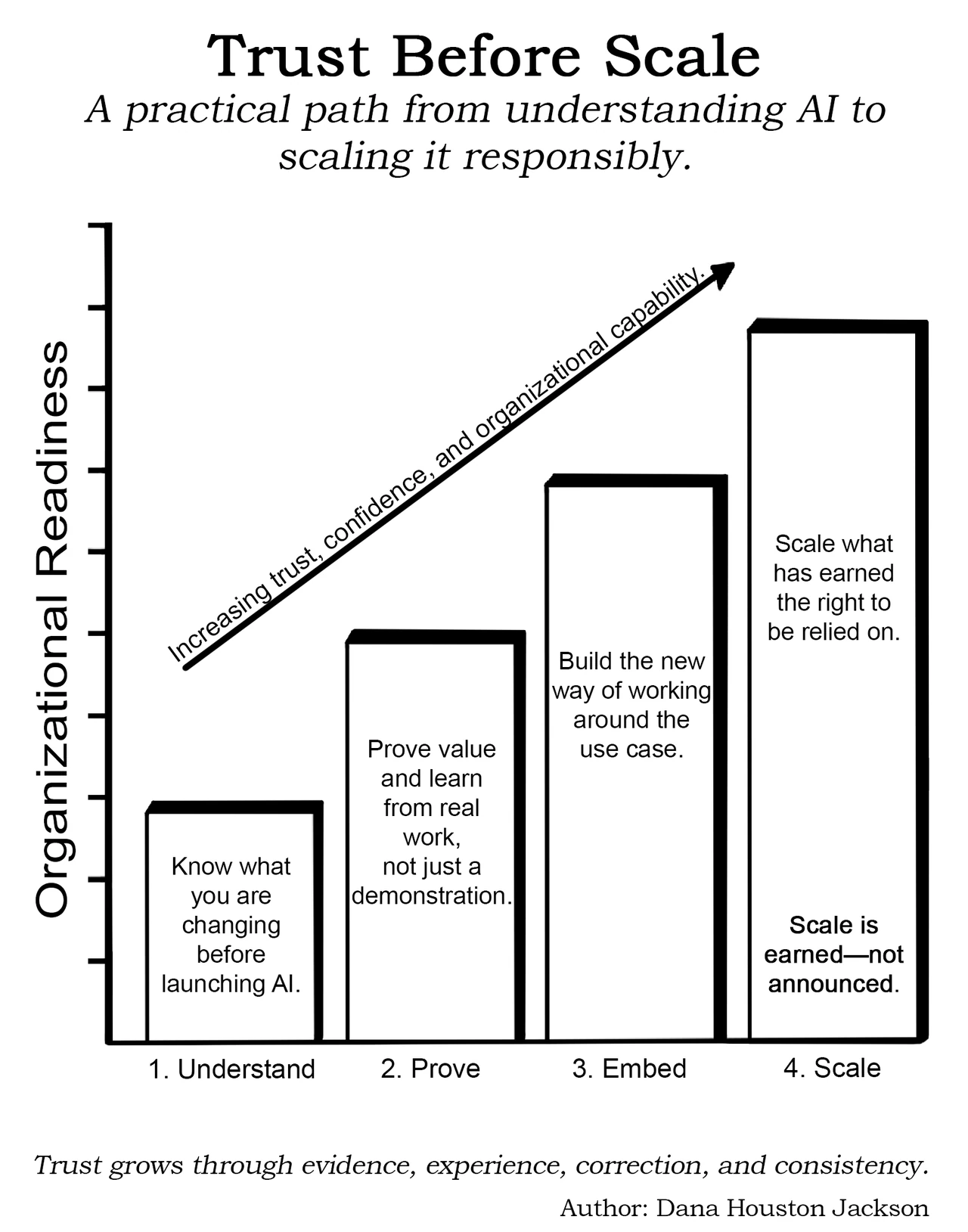
Organizations often ask people to trust a technology because leadership has already decided to scale it. That reverses the sequence.
Trust should be built through experience, transparency, appropriate safeguards, useful outcomes, and visible human accountability. Then scale what has earned the right to scale.
High-Value / Low-Regret
A Dana Houston Jackson framework

Not every possible AI use case is a good place to start. Early adoption should focus on opportunities where people can experience meaningful benefit while the consequences of an imperfect experiment remain manageable.
That creates learning, confidence, evidence, and trust before the organization moves into higher-risk applications.
The Evidence Ladder
A Dana Houston Jackson framework

Activity is not the same as adoption. A stronger view of adoption looks at evidence across four levels:
- Activity — What did people do?
- Behavior — Did the way they work change?
- Performance — Did the work become better, faster, safer, or more effective?
- Capability — Can the organization sustain, improve, and expand what it learned?
Calibrated Trust
A Dana Houston Jackson framework

Neither overtrust nor avoidance — the conditions leaders need to create for people to develop appropriate, justified trust in AI and change.
The Absorption Gap
A Dana Houston Jackson framework

Where organizations struggle to absorb change — and the leadership and design conditions that determine whether the new way of working sticks.
Stop Trying to Turn Friction Off

Not all friction is bad. In fact, some tension is useful because it surfaces differences, forces better questions, and can lead to stronger decisions. The problem starts when leaders treat every disagreement, delay, or pushback as a personality problem, a bad attitude, or “resistance to change.” Sometimes what looks like people friction is really a system-design problem: unclear roles, competing priorities, poor handoffs, conflicting incentives, or authority sitting in the wrong place. The goal is not to eliminate friction. It is to understand what is causing it and keep the organization in the zone where tension produces learning instead of chaos.
The Coordination Cycle

Change does not happen in one clean pass from idea to implementation. In real organizations, leaders are constantly receiving signals, interpreting incomplete information, making decisions, testing responses, and adjusting based on what happens next. I created this cycle to make that process visible. The important part is that the people closest to the work are involved in interpreting what is happening and shaping the next move. This is less about creating a perfect plan up front and more about building a repeatable way to notice, decide, test, learn, and adapt as conditions change.
Where Did the Productivity Go?

When leaders say productivity is falling, the instinct is often to look at the people. Are they working hard enough? Are they engaged? Are they resisting? I created this pipeline model for an AEC leadership team to show that productivity can leak out of the system long before it reaches the bottom. Communication breakdowns, supply-chain friction, design conflicts, approval delays, coordination issues, and repeated handoffs can all squeeze the flow of work. The point is not that people do not matter. It’s that sometimes the fastest way to improve performance is to stop blaming the worker and look at what the system is making harder than it needs to be.
The Friction Tax
A Dana Houston Jackson framework

As organizations grow, coordination does not grow in a nice straight line. The number of possible communication and coordination relationships rises quickly, and more organizational energy can get consumed just keeping people aligned. That is the Friction Tax. It shows up as meetings, handoffs, clarification, approvals, rework, escalation, and the constant effort required to keep a larger system moving. Created for a smaller Technology consulting firm, the lesson is not “stay small.” It is that scale has an operating cost, and leaders have to redesign how information, decisions, and accountability move if they want to preserve execution capacity as the organization grows.
Wisdom Friction vs. Waste Friction
A Dana Houston Jackson framework
Not all friction is bad. Wisdom friction is the hard-won caution that keeps people safe and work right: a second check, a hold point, a question from someone who has seen it go wrong. Waste friction is the habit that outlived its reason. This field guide helps utility, architecture, engineering and construction supervisors tell the two apart and decide what to keep, cut or fix.
Read the field guide →