Wisdom Friction vs. Waste Friction: A Field Guide for Utilities and AEC Supervisors
The Inherited Operating System for Organizations – Expired Assumptions | Utilities and AEC Edition
A field guide for supervisors in utilities, architecture, engineering and construction: how to tell the friction that protects people from the friction that just slows everyone down, and what to do about each.
By Dana Houston Jackson, Founder and Principal Change Architect, Change – With a Coach Approach, LLC
In a nutshell – what we learned (right or wrong)
The big idea: Utilities and AEC firms aren’t slow because of their people. They were built for work where a mistake can hurt someone, black out a city or put a firm’s name on a failed design.
What’s expired: Treating every kind of friction the same: the review that protects the public and the report nobody has read since 2014.
What replaces it: Sorting wisdom friction from waste friction, then responding to each one differently, out loud, every time someone in the field raises it.
I’ve spent a good chunk of my career in and around construction, engineering and utilities. I started in electrical construction, studied engineering and electrical construction management, and worked as a transmission and distribution program manager, an engineering business analyst, a project manager and a change manager for utilities in California, the Pacific Northwest and the Midwest. These days I work with engineering and design firms too. So when someone tells me these organizations are slow because their people are slow, I have one answer: that dog won’t hunt.
The people aren’t slow. They’re careful, because the system was designed by folks who saw what happens when nobody is. This article gives managers a practical way to sort the friction they hear about every week and a way to respond to it. It takes about 12 minutes. The field guide in the middle is the part to keep handy: real things you’ll hear in utilities, architecture, engineering and construction, what each one may signal, what to ask and what to do.
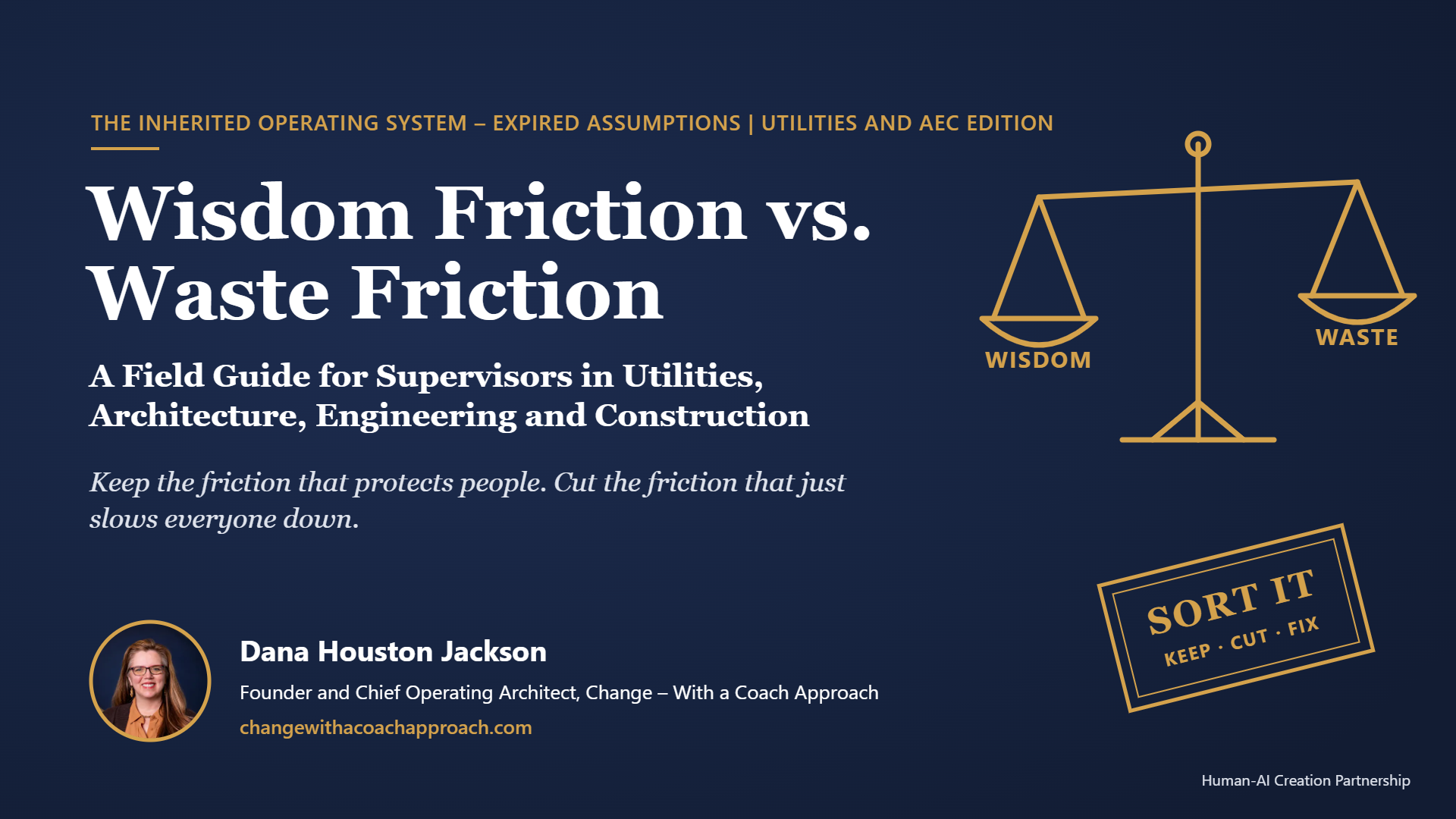
Wisdom friction vs waste friction
In my book, The AI Adoption Traps, I take the heat off “friction” as always being a bad thing. Wisdom friction slows you down on purpose, where speed is dangerous. It protects judgment, quality, safety, relationships and accountability. Waste friction slows you down by accident, everywhere: unnecessary searching, repeated formatting, duplicate data entry, waiting on unclear owners and rework caused by poor process design. Some of it has been sitting there so long it’s got its own parking spot.
AI makes the second kind painfully visible. It can do the work in hours and then watch it wait for weeks. Here’s the sorting problem in one place.
| Wisdom friction (keep it) | Waste friction (retire it) | |
|---|---|---|
| Utilities | Switching orders and lockout/tagout. NERC CIP cybersecurity controls. Evidence that shows a cost was prudent. A human sign-off on anything that touches life, the grid or a customer’s bill. | Five signatures on a decision one qualified person could make. Re-approving the same vendor every year as if you’d never met. Paper trails kept “just in case.” A steering committee to approve a 90-day pilot. |
| AEC firms | Senior QA/QC review before sealed plans go out. The engineer in responsible charge who stamps the design. A go/no-go on a pursuit with fee risk. A second look at an RFI response. A conversation before moving a young professional to another office. | Re-keying the same project data into three systems. Reformatting every resume for every pursuit. Hunting for the latest standard detail. An approval that sits because nobody’s sure who owns it. A weekly status report nobody reads. |
Reduce waste friction. Protect wisdom friction. And don’t remove wisdom friction by accident, whether the thing doing the removing is AI, a reorg, a new system or a deadline.
How it got handed down
Most of the inherited operating system in this series came from factories and government offices. Utilities and AEC firms got a stronger dose, for good reasons. A wrong switching order can kill a lineworker. A design error can put the public at risk, which is why states license engineers and hold one person in responsible charge. So both industries stacked Taylor’s procedures, Weber’s rules and Fayol’s chain of command higher than almost anyone else, and then added a regulator or a licensing board on top.
In the upcoming book Leading a Five-Generation Workforce, we write that “institutional knowledge does little for the organization if it remains inside one person’s head.” Every review layer was added by someone who learned a hard lesson. What got handed down was the layer. The lesson behind it often retired. Nobody designs a heavy organization on purpose. A mistake happens, so a review gets added. The review slows things down, so a status meeting gets added. Each step made sense on the day it showed up. Few of them came with a sunset date.
Where it shows up now
In utilities, nowhere is it clearer than the interconnection queue, the line of power plants and batteries waiting to connect to the grid. Berkeley Lab’s Queued Up: 2026 Edition found the median project built in 2025 took 61 months from request to operation, up from 36 months in 2015. FERC’s Order No. 2023 changed the study rules. The approval habits inside many utilities didn’t.
In AEC firms it shows up as growth. A firm that adds offices, acquisitions and new service lines adds handoffs, systems and approvals right along with them. Five people have 10 working relationships. Fifteen have 105. Each new connection brings a little coordination cost, and those costs pile up into what I call the Friction Tax. Meanwhile AI arrives. According to an ACEC Research Institute survey cited in ACEC’s October 2025 AI primer, 63% of member firms had an AI strategy or were building one. The tools are moving faster than the approval paths around them.
Field guide for supervisors: what you’ll hear, what it means and what to do
Here’s where it gets practical. As a supervisor, you rarely find friction on a process map. You hear it, on site, at the coffee pot and in the last five minutes of a meeting. Your job is to sort it on the spot: listen for the signal, ask one or two questions to check it, then keep it, cut it or fix it. These examples are made up, but you’ve heard every one of them.
The 30-second test
| Ask | Points to wisdom friction | Points to waste friction |
|---|---|---|
| What does this step protect? | Someone can name it: the public, a crew, a client, quality, a person, the firm’s name. | Nobody can say, or the answer is “just in case.” |
| When did it last catch something real? | Recently, and people can tell you the story. | Nobody remembers. |
| Does it scale with the risk? | More scrutiny for higher stakes. | The same weight on a $15K task order as a $2M pursuit. |
| Who owns it? | One named person who knows why it exists. | “Corporate,” “IT” or “I think Bob started it.” |
Words worth listening for
Often waste: “again,” “we’ve always,” “just in case,” “I’m still waiting on…,” “nobody reads it,” “retype,” “I couldn’t find…,” “three signatures.”
Often wisdom: “before it goes to the client,” “I want to see it myself,” “what if,” “is it safe,” “who stamps this,” “can I talk with them first.”
Often both: “It’s stuck in review.” The review may be wisdom. The waiting usually isn’t. Keep the check and fix the wait.
Utilities
| If someone says… | What it may signal | Ask to check | What you do |
|---|---|---|---|
| “I’m not signing that switching order until I walk it down myself.” | Wisdom. A safety check that protects a crew. | “What would you be looking for?” (Listen. Don’t argue.) | Keep it. Protect the time in the schedule. Let AI pre-fill the order from the one-line so the walk-down is the only slow part. |
| “We re-approve the same tree-trimming contractor every year like we’ve never met them.” | Waste. A process built for new vendors applied to everyone. | “Has the renewal ever turned up a problem? Who owns it?” | Cut or right-size it. Risk-tiered renewal with one owner and a checklist. Save the full review for new vendors and real changes. |
| “AI drafted the outage update in two minutes. Then it sat three hours waiting on approval.” | Both. Checking accuracy is wisdom. The queue is waste. | “What does the approver check? Has it ever changed the message?” | Fix it. Pre-approve templates, name an on-call checker for restoration times and areas, and let it go. |
| “I don’t trust the AI’s load forecast, so I rerun it by hand.” | Wisdom today. Waste if it never ends. | “What would it take for you to trust it?” | Run both side by side for a set time with agreed criteria. Then retire the manual run or keep a spot-check. |
Architecture
| If someone says… | What it may signal | Ask to check | What you do |
|---|---|---|---|
| “I want the code consultant to look at egress before we issue.” | Wisdom. Life safety. | “Did occupancy or egress change, or is this a cosmetic revision?” | Keep it for real changes. Book it early so it doesn’t hold the issue date. |
| “I’ve redrawn the door schedule three times because the client keeps changing hardware.” | Waste. A gap in change control, not a drafting problem. | “Who approves client changes? Is there a decision log? Is it in our fee?” | Fix it. Start a client decision log and an additional-services trigger. AI can track and summarize changes. |
| “Every rendering tweak has to go through the principal.” | Probably waste. An approval habit. | “What has the principal caught in the last ten?” | Tier it. The principal sees concept-level moves. The project architect approves minor revisions. |
| “I’m copying specs from the last project and hoping they fit.” | Both. The hunting is waste. Skipping the spec review is risky. | “When was the master spec last updated, and who owns it?” | Fix the library and give it an owner. Keep a spec review before issue. |
Engineering
| If someone says… | What it may signal | Ask to check | What you do |
|---|---|---|---|
| “I want a senior QA/QC review before these sealed plans go to the client.” | Wisdom. The stamp and the public. | “What level of review fits this project’s risk?” | Keep it. Put it in the schedule and the fee. Scale it: a major interchange gets more than a parking lot restripe. |
| “This $15K task order needs three signatures.” | Waste, or wisdom grown too heavy. | “Who would notice if two of those went away?” | Cut it to risk-based approval thresholds with one owner. |
| “I typed the same project info into three systems again.” | Waste. No single source of truth. | “Which system is the real one? Who owns the others?” | Log it and take it to the systems owner, with a date. Ask whether automation or AI can move the data. |
| “AI wrote the proposal section, so nobody needs to read it.” | Removing wisdom by accident. | “Who’s putting their name on this?” | Keep the review. AI drafts. A human owns it. |
Construction
| If someone says… | What it may signal | Ask to check | What you do |
|---|---|---|---|
| “We’re not pouring until the inspector signs off on the rebar.” | Wisdom. You can’t un-pour concrete. | “Is the inspection booked, or are we waiting to call?” | Keep it. Book inspections ahead so the check isn’t the delay. |
| “I spend an hour every night on the daily report, then retype it into the owner’s system.” | Waste. Double entry. | “What does the owner actually need from us? Could it go in once?” | Cut the retyping. One entry. AI or voice-to-text can draft it from photos and notes, and the superintendent reviews it. |
| “That submittal’s been sitting with the design team for three weeks.” | Both. The review is wisdom. The wait is waste. | “Is it waiting on review or on routing? What does the contract say about turnaround?” | Keep the review. Fix the routing. Track turnaround and raise it at the OAC meeting. |
| “Do we really need the morning safety huddle? It’s the same work every day.” | Wisdom that feels like waste. | “What’s different today? Crew, weather, equipment?” | Keep it, and keep it short. Make it about today’s risks and rotate who leads it. |
Across all four
| If someone says… | What it may signal | Ask to check | What you do |
|---|---|---|---|
| “Can I talk with her before we move her to the other office?” | Wisdom. A relationship and a person’s career. | “What do you want her to hear from you?” | Keep it. A staffing move made fast and cold costs more later. |
| “We’ve always had the Monday status meeting.” | Probably waste. Spring cleaning candidate. | “What decision does it produce?” | Cancel it for a month and see who notices. |
Then follow through
If you keep it: name the owner, put it in the schedule and the fee, and explain why it matters, so newer staff don’t mistake it for bureaucracy.
If you cut it: give it an owner and a date, try going without it for 30 days, and tell the person who raised it what happened. That’s how you get the next signal.
If it’s both: keep the check and remove the wait. Most “stuck in review” problems are routing, not reviewing.
Four habits for responding well
However you sort it, how you respond decides whether people keep telling you.
Thank before you sort. The person who raised it just handed you a signal. If they get a lecture, you won’t hear the next one.
Ask what it protects. If they can name it (the public, a lineworker, a client, quality, a person, the firm’s name), it may be wisdom. If nobody can remember when it last caught something real, it may be waste.
Watch the strong year. When business is good, it’s tempting to label every review as red tape. The goal isn’t to cut all friction. It’s to tell the two apart.
Give waste an owner and a date. “We should fix that” is how waste friction lives forever. A name and a date are how it leaves.
Make it a spring cleaning habit
Operational weight doesn’t clear itself. The fix is a regular spring cleaning, where leaders walk through the processes, approvals, meetings and reports they’ve piled up and decide what stays. Wisdom vs waste is the sorting rule. Two tests help: Is the value proportional to the effort? Is it fit for today, or for the organization we were three years ago? Then ask a few plain questions. What approvals have become heavier than the value they add? What are we maintaining mostly because we’ve always had it? Where are we creating more coordination than the project needs? Put it on the calendar once or twice a year, the same way you’d book a QA/QC review, so it isn’t left to whoever has time.
Who’s allowed to act?
Here’s the good news: both industries already run on “allowed to act” in the moments that matter most. Most safety programs give every worker stop-work authority. NERC’s TOP-001 standard requires transmission operators to act to keep the grid reliable. A licensed engineer’s stamp means one accountable person owns the design. None of these is a committee. Each one is a named role with clear authority and clear limits. So the question isn’t whether these organizations can handle “allowed to act.” It’s why we trust it in an emergency and not on a regular Tuesday.
Holacracy and sociocracy push this further. Holacracy gives the person in a role the authority to act on its purpose, inside written limits it calls domains and policies. Sociocracy moves a proposal ahead when it’s “good enough for now, safe enough to try.” You don’t have to adopt either one to borrow the idea. AI work sorts into three lanes.
| Lane | Utilities | AEC firms |
|---|---|---|
| Act now | Stopping a job that looks unsafe, even when the AI-built schedule says go. An operator overriding an AI recommendation in real time. | Stopping work on site that looks unsafe. Flagging a design issue the moment you see it, whatever the AI check said. |
| Act inside pre-approved policy | Using an approved AI tool for drafts, summaries, inspection notes and first-pass screening, with a named person checking the output. | Using an approved AI tool for meeting notes, proposal drafts, resume tailoring, spec searches and first-pass QC checklists, with a named person checking. |
| Ask first | Changes to switching or system operations. Any AI tool touching a high- or medium-impact BES Cyber System (NERC CIP-010). New uses of customer data. | Anything that goes under a PE stamp. Client data or contract terms used in a new way. Changes to how people’s jobs are done or measured. |
Put the Ask first list on one page, with the rule behind every item. Everything else goes in the middle lane, and the people who use it well get recognized, not side-eyed. The goal isn’t fewer rules. It’s knowing which rule you’re following, and why.
Unlearn to make room
| What many of us were taught | Why it’s expired | Make room for |
|---|---|---|
| More signatures make a decision safer. | Past a point, more signatures spread accountability so thin nobody owns the risk. | Decision rights by risk tier, with one clear owner. |
| Compliance and QA/QC are the last step. | Checking at the end finds problems when they’re most expensive to fix. | Checks built into the work, with an AI-logged record of what was checked. |
| Friction is the enemy of speed. | Some friction is the reason clients and the public trust you. | Sorting wisdom from waste, out loud, every time. |
Check your own organization
Picture a mid-sized utility with a long interconnection queue. Its planning team starts using AI for first-pass screening and draft study reports. A review that took an engineer three weeks now takes an afternoon, plus a careful engineering check. Then it sits in six approval queues for nine weeks. When the utility finally sorts them, two are wisdom: the engineering sign-off and the regulatory review. The other four collapse into one owner with a checklist. Now picture a regional engineering office where AI drafts a pursuit package in a day, and it waits two weeks for three signatures on a go/no-go nobody disputes. Same problem. Different hard hat.
- Which approvals in your shop protect people, the public or the client, and which just protect a habit?
- When someone in the field complains about a step, do they hear “thank you” or “that’s policy”?
- Who is allowed to approve an AI pilot, and how long does it take?
- Where do your checks happen: inside the work or at the end?
- How well are you transferring judgment before experienced people reduce their hours, retire or change roles? (That question is from our upcoming book.)
One small first step: Grab two sticky notes. On one, write a step in your work that feels heavier than it did one to three years ago. On the other, write one that feels lighter. Ask of the heavier one: wisdom or waste? If it’s waste, who can remove it, and by when? If it’s wisdom, how do we keep it from being “streamlined” away? Then mosey over to your next team meeting and ask one question: “Who would notice if this went away?”
Back to the series: the eight parts of The Inherited Operating System are on the Articles page.
Quick answers
What is wisdom friction?
Wisdom friction is a deliberate pause that protects judgment, quality, safety, relationships or accountability. Examples are a QA/QC review before sealed plans go out or a switching order walk-down. Keep it and make it efficient.
What is waste friction?
Waste friction is effort that slows people down and protects nothing, like duplicate data entry, reformatting the same document or an approval with no clear owner. Give it an owner and remove it.
How does a manager tell them apart?
Ask what the step protects and when it last caught something real. If nobody can answer, it’s likely waste. The same step can be wisdom on a high-risk project and waste on a low-risk one, so scale it to the risk.
Does AI remove friction?
AI can cut waste friction in drafting, formatting, searching and summarizing. It can also remove wisdom friction by accident when people skip the human review. AI drafts. A human owns it.
What is organizational spring cleaning?
A regular review, once or twice a year, where leaders sort their processes, approvals, meetings and reports into wisdom and waste, then keep the first and retire the second.
Keep reading
- Your Organization Is Running on 100-Year-Old Code (where this series starts)
- When “The Rule Is Safer Than Your Judgment”: What Max Weber Actually Warned Us About
- It’s Not a Tech Problem: What Adaptive Leadership Knows About Making AI Work
- The Corrective Action Gap Between Paperwork and Reality
Want the whole model? Wisdom friction and waste friction come from Chapter 3 of The AI Adoption Traps. Get the book here, or see more of Dana’s models on the Frameworks page.
Bring this to your team. Dana runs leadership and change workshops for AEC and utility teams, including a Wisdom Friction vs. Waste Friction session for supervisors and project leaders.
Sources
Houston Jackson, Dana. The AI Adoption Traps. 2026. Chapter 3, The Absorption Gap (Waste Friction vs. Wisdom Friction).
Houston Jackson, Dana, et al. Leading a Five-Generation Workforce. Forthcoming, April 2027.
American Council of Engineering Companies (ACEC) Technology Committee. A Primer on AI Integration for Engineering Firms. October 2025. https://www.acec.org/
Berkeley Lab. Queued Up: 2026 Edition. June 2026. https://emp.lbl.gov/queues
Federal Energy Regulatory Commission. Order No. 2023, Improvements to Generator Interconnection Procedures and Agreements. July 28, 2023.
NERC. Reliability Standards TOP-001-5 (Transmission Operations) and CIP-010-4 (Configuration Change Management). https://www.nerc.com/
Occupational Safety and Health Administration. 29 CFR 1910.269, Electric Power Generation, Transmission, and Distribution.
HolacracyOne. Holacracy Constitution, version 4.1. https://www.holacracy.org/constitution/4-1/
Sociocracy For All. “The Liberating Effect of ‘Good Enough for Now.’” https://www.sociocracyforall.org/the-liberating-effect-of-good-enough/
Related: Robert I. Sutton and Huggy Rao, The Friction Project (2024), on good and bad friction.

Dana Houston Jackson is Founder and Principal Change Architect of Change – With a Coach Approach, LLC, author of The AI Adoption Traps and co-author of the upcoming Leading a Five-Generation Workforce (April 2027). A straight-talking Texan with 30 years of experience, she helps leaders make change less confusing, less painful and far more useful. She holds a master’s degree in Organizational Change Leadership and is a PMP, CCMP, Prosci trainer and ICF Professional Certified Coach. Visit changewithacoachapproach.com or connect on LinkedIn at linkedin.com/in/danahoustonjackson.